“Art washes away from the soul the dust of everyday life.” — Pablo Picasso
Over the years, I’ve come across so many majestic paintings on walls. Usually, my only reaction was to pull out my camera, snap a photo, or maybe take a quick selfie. Whether I was in a fine-dining restaurant, a corporate lobby, or even a hospital, I saw them as nice backdrops—but I never really stopped to think about what they were doing to the space.
I still remember the day I truly understood the power of a wall.
I was walking through a dull neighborhood with grey roads, grey buildings, and the constant noise of traffic. Then I turned a corner and suddenly stopped.
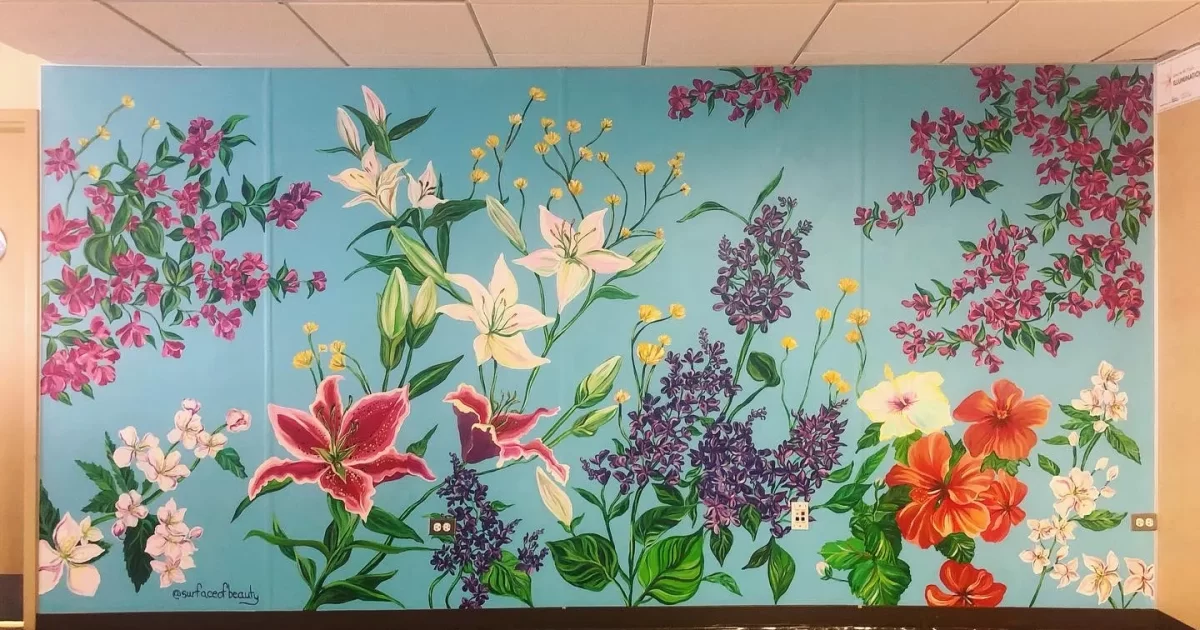
There was a woman standing on a scissor lift, transforming a bleak industrial wall into a riot of blooming energy. It was Natasha May Platt, the artist known as “Surface of Beauty.” I watched, mesmerized, as she worked. It wasn’t just that she was painting flowers; it was the way she was painting them. There was a rhythm to her movement.
Everyday I would see her work and then one final day, she was gone. Her mural was done.
I stood there for twenty minutes, just soaking it in. And then it hit me: If a wall on a street corner can change my entire mental state in moments, why are we staring at blank, beige walls for 40 hours a week at work?
We treat our workspaces like containers—boxes where we go to produce output. But we are not machines; we are biological entities that crave connection, color, and story. When I started researching the impact of environmental design, I realized that what Natasha was doing wasn’t just “decoration.” It was psychological alchemy.
If you are a business owner, a team lead, or just someone tired of staring at “Office White” paint, here is what I’ve learned. A mural isn’t a frivolous expense; it’s a strategic tool. Here are five ways a mural design can fundamentally shift your workspace.
5 Reasons Your Office Walls Are More Powerful Than You Think
1. The “Vibe Check” is Real (and it happens in 3 seconds)
Let’s be honest. When you walk into a new office, you make a judgment call instantly. It’s primal.
I once interviewed at a tech company that bragged about being “disruptive.” They talked a big game. But when I walked into their lobby, it was dead silent. Grey carpet. Grey walls. A generic stock photo of a bridge on the wall. The air felt stale. My gut instinct screamed: Run. You will die of boredom here.
Contrast that with a studio I visited recently. Before I even spoke to the receptionist, I was hit by this wave of color. Someone had painted a mural that wrapped around the corner—abstract shapes, weird neons, little hidden details. It didn’t even have the company logo on it. It didn’t need to. The wall said, “We are alive. We take risks. We aren’t afraid of making a mess to make something cool.”
A mural is the ultimate non-verbal communication. It’s a handshake for your eyes. If you want clients to think you’re creative, you can’t just say it in a brochure. You have to let the walls scream it.
2. The “Soft Fascination” Theory (Or: Why your brain needs a break)
I found this concept called “Soft Fascination” while I was researching why I liked Natasha’s flowers so much.
Here’s the deal: trying to focus on an Excel sheet uses “Directed Attention.” It’s hard work. It drains your battery. To recharge, you can’t just stare at a blank wall—that’s boring. But you also can’t stare at a TV screen—that’s too stimulating.
You need the Goldilocks zone. You need something complex enough to tickle your brain, but not so demanding that you have to analyze it.
That’s what a mural does.
Imagine you’re stuck on a coding problem. You spin your chair around. If you stare at a white wall, your brain just loops on the problem. But if you stare at a complex, tangled jungle scene painted on the wall? Your eye starts to trace a vine. It notices a pop of blue in the corner. It wanders.
That wandering is the rest. It’s a micro-vacation. Two minutes of staring at art, and you turn back to your desk with a fresh battery. We keep trying to make offices “distraction-free” to boost productivity, but it turns out, we actually need the right kind of distraction to function as human beings.
3. Biophilia (Because we aren’t built for drywall)
We are animals. I know, we wear suits and use iPhones, but genetically? We are still hunter-gatherers who are supposed to be walking through forests, scanning for fruit and predators.
We are hardwired to feel calm when we see nature. The shapes of leaves, the fractals in a flower petal, the gradient of a sunset.
When you put a human in a box with straight lines and fluorescent lights, the reptile part of our brain gets stressed out. It’s subtle, but it’s there. A low-level hum of anxiety.
Natasha May Platt’s work hits hard because she brings the garden inside. Even if you can’t keep a fiddle-leaf fig tree alive (guilty), a painted garden doesn’t die. It doesn’t need water. But it still tricks your brain.
I’ve seen offices that feel like bunkers transform just because someone painted a landscape on the back wall. Suddenly, the room feels bigger. The air feels lighter. It’s not magic; it’s biology. If you can’t knock down a wall to put in a window, paint a window. Paint a forest. Just give your brain something organic to latch onto.
4. Getting Lost vs. Knowing Your Place
Have you ever worked in one of those open-plan farms where every desk row looks identical? It’s a nightmare. You feel like a cog in a machine. “Meet me at the third row of desks past the second pillar.” What?
Murals are the best wayfinders.
“Meet me by the Giant Octopus.” “Let’s talk over by the Sunflowers.” “The coffee machine is near the Abstract Blue Wave.”
It gives a space geography. It turns a “floor plan” into a “place.” It anchors memories. You remember the conversation you had by the Octopus wall differently than the one you had in the beige conference room. It helps employees claim the space. It stops feeling like a rented facility and starts feeling like home.
5. The “I Want to Work There” Factor
Look, we live in a visual world. We document everything.
If I’m a young creative, or a developer, or a project manager, and I’m choosing between two job offers… I’m going to look at your Instagram tags. I’m going to look at the photos your employees post.
If I see photos of people having coffee in front of a killer mural, smiling, looking like they are in a cool space? That registers. It signals culture. It says, “This company cares about the experience of being here.”
A mural is a recruiting magnet. It’s the backdrop for the team selfies, the LinkedIn announcements, the holiday party photos. It’s the visual flavor of your company culture. If your walls are boring, people assume your culture is boring. Is that fair? Maybe not. But it is true.
So, what do you do?
Don’t just go to a hardware store and buy a stencil.
The reason Natasha’s work made me stop was the soul in it. The intention. She talks about how the repetition of painting the flowers is a meditation for her. That energy transfers to the wall, and then it transfers to the people looking at it.
If you want to do this, find an artist. Not a sign painter—an artist. someone with a style. Give them a wall and tell them, “Make us feel something.” Ask your team what they want. Do they want energy? Calm? Whimsy?
Stop treating your workspace like a storage unit for humans. Treat it like a temple for the work you do.
We spend a third of our lives in these rooms. For the love of God, let’s make them beautiful.